On this page
- What is visualisation in sport?
- What happens in your brain
- Does visualisation actually improve performance?
- What makes imagery effective: the PETTLEP model
- First person or third person?
- How to practise visualisation: a step-by-step method
- Imagery for different sports
- Using imagery to manage nerves
- Imagery for confidence
- Imagery during injury
- Using video to sharpen your imagery
- How good is your imagery?
- For coaches and parents
- A four-week imagery plan
- Common mistakes
- The bottom line
- FAQ
- Sources
The short version
- Imagery means mentally rehearsing a skill or situation using as many senses as possible, not just picturing a win.
- Imagining a movement activates many of the same brain areas as doing it, which helps explain why it works.
- Meta-analyses find imagery improves sports performance, with the biggest effects when it's combined with physical practice.
- Realistic, detailed imagery (right place, right kit, right feelings, real time) works better than vague daydreaming.
- Start with 5 to 10 minutes, three or four times a week, and include how you'll handle mistakes and pressure.
Before a big race, a lot of athletes say they "visualise". Ask what that means and the answers vary wildly. For some it's a detailed mental run-through of every corner of the course. For others it's a vague image of crossing the line with arms raised, held for a few seconds before they get distracted by their phone.
Only one of those is likely to help. Mental imagery, done properly, is one of the most researched skills in sport psychology, with decades of studies behind it. Done vaguely, it's mostly daydreaming.
This guide explains what imagery is, what happens in the brain when you use it, what the research says about performance, and a practical method for building it into your training so it actually carries over to competition.
What is visualisation in sport?
Sport psychologists usually prefer the term imagery to visualisation, because good imagery uses more than just sight. It means creating or recreating an experience in your mind, using as many senses as you can: what you see, hear and feel in your body, the feel of the ball or the bar, the smell of the pool, the rhythm of your breathing.
Imagery can be used for many things:
- Rehearsing skills: a golf swing, a tennis serve, a gymnastics routine, a penalty kick.
- Rehearsing strategy: race tactics, set plays, how you'll pace a climb.
- Rehearsing situations: the warm-up, the walk to the start line, responding to a mistake.
- Managing arousal: calming down or firing up before competing.
- Building confidence: recalling past performances that went well.
- Staying sharp when injured: keeping skills fresh when you can't practise physically.
What happens in your brain
One reason imagery works is that imagining a movement uses many of the same brain areas as actually doing it. A 2013 meta-analysis of brain-imaging studies by Sébastien Hétu and colleagues found that motor imagery consistently activates a network that overlaps substantially with the one used for real movement, including regions involved in planning and coordinating actions.
The overlap isn't complete. The muscles don't fire in the same way, and some areas are less active. But this "functional equivalence" helps explain why mentally practising a skill can strengthen the neural patterns behind it, and why imagery seems to work best when it's as close as possible to the real thing.
Does visualisation actually improve performance?
Yes, and the evidence goes back a long way.
In 1994, James Driskell and colleagues published a meta-analysis of 35 studies on mental practice. They found that mental practice improved performance compared with no practice, with larger effects for tasks that involve more thinking and decision-making. It was less effective than physical practice, but it clearly helped.
A 2021 meta-analysis focused specifically on sport, by Bianca Simonsmeier and colleagues, pooled many intervention studies and found that imagery interventions improved motor performance, motivation and confidence, and reduced anxiety. The effects on performance were moderate in size.
A 2021 review by Anna Ladda and colleagues on motor imagery practice reached a similar conclusion, adding that combining imagery with physical practice tends to give the best results. Imagery is a supplement to training, not a replacement for it.
What makes imagery effective: the PETTLEP model
In 2001, sport psychologists Paul Holmes and David Collins proposed a framework for making imagery as similar to real performance as possible. It's called PETTLEP, and it's still widely used by sport psychologists. Each letter is one element to match:
| Element | What it means | In practice |
|---|---|---|
| Physical | Match your body position and sensations | Stand like you would for a serve; hold a racket, club or ball; wear your kit |
| Environment | Match the setting | Do imagery at the venue, or use photos and video of it |
| Task | Match the skill and your level | Imagine what you can realistically do, with your current technique |
| Timing | Match real-time speed | Rehearse at the speed the action happens, not in slow motion (except to learn details) |
| Learning | Update imagery as you improve | Change scripts as your skills and tactics change |
| Emotion | Include the feelings you'll have | Feel the nerves, excitement and focus of competition |
| Perspective | Choose first or third person deliberately | Through your own eyes for timing and decisions; watching yourself for form |
You don't need to hit every element every time. But the closer your imagery is to the real experience, the more likely it is to carry over.
First person or third person?
There are two main perspectives:
- Internal (first person): you see through your own eyes, as if you're actually performing. Useful for timing, decisions, reading the game and feeling the movement.
- External (third person): you watch yourself as if on video. Useful for checking body position and form, such as in gymnastics, diving or a golf swing.
Neither is "correct". Many athletes switch between them depending on what they're working on. If you're new to imagery, start with whichever feels more natural.
How to practise visualisation: a step-by-step method
Step 1: pick one specific situation
Don't try to imagine an entire match. Start with one short, specific moment: your first serve, the first 400 metres of a race, taking a penalty, the start of a swim, your opening drive.
Step 2: set the scene
Sit or stand in a position that matches the action if possible. Close your eyes. Take two slow breaths. Then build the environment piece by piece: where you are, the light, the surface under your feet, the sounds around you, the temperature.
Step 3: add your body
Notice what you're wearing, what you're holding, your posture, your breathing, your heart rate. If you'd feel nervous in that moment, let yourself feel nervous.
Step 4: run the action in real time
Go through the skill at normal speed. Feel the movement as well as seeing it. Notice the decision points. Hear the sounds. Finish with the outcome you want, then a second or two after it.
Step 5: repeat, then add a challenge
Repeat three to five times. Once it feels clear, add a complication: a mistake, a strong opponent, bad weather, a fast start from the runner next to you. Rehearse how you respond and recover.
Step 6: keep it short and regular
Five to ten minutes, three or four times a week, is plenty to start. Consistency matters more than session length.
"I'm standing on the start line. The air's cool and smells of grass. I can feel my heart beating fast and my legs feel light. I hear the starter call us forward. I take one slow breath out and say 'smooth'. The horn goes. I start quickly but in control, staying in my lane, letting the faster runners go. My breathing settles by the first corner. I check in with my shoulders and relax them. I hit my first kilometre marker feeling strong and steady."
Imagery for different sports
Team sports
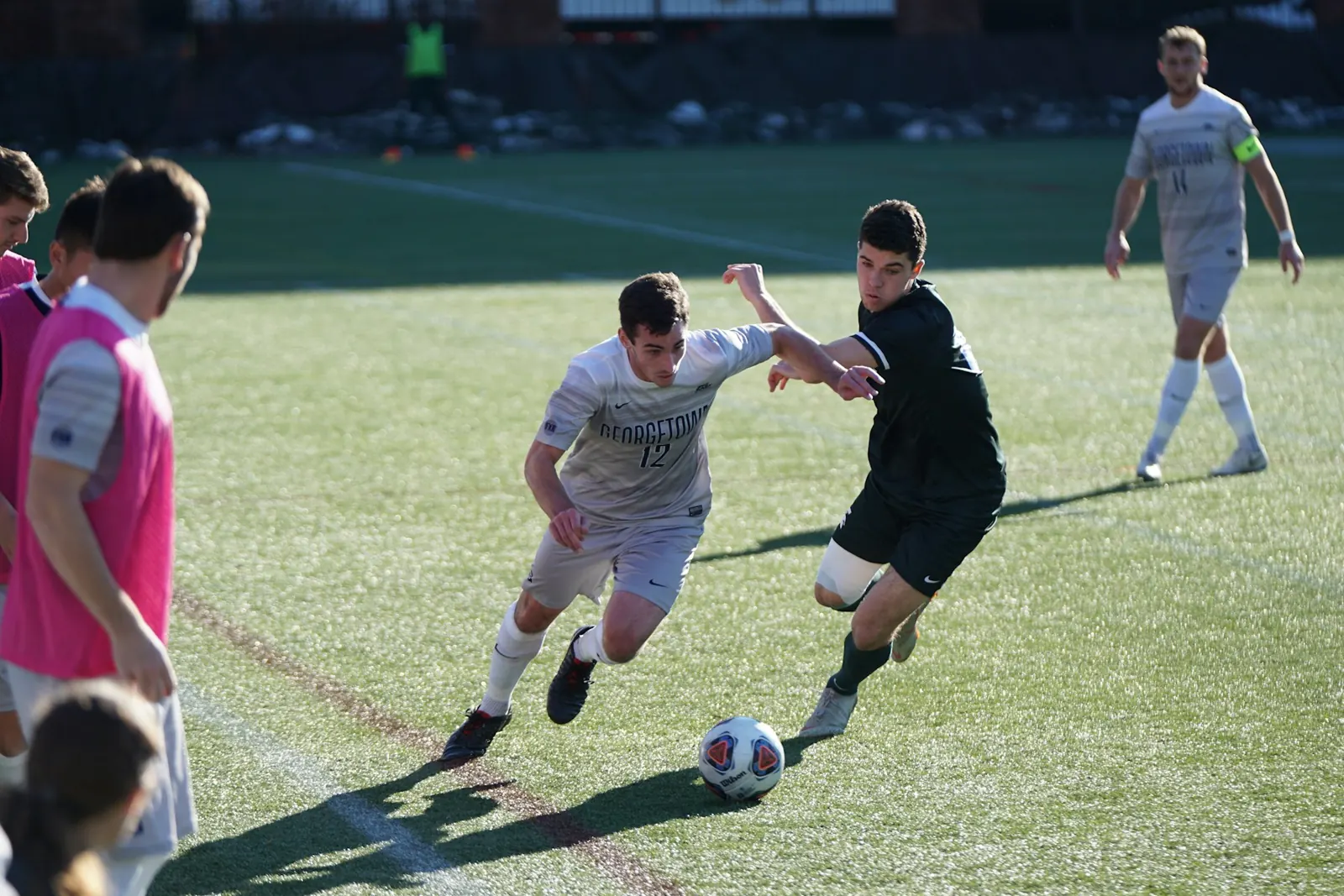
Rehearse specific moments: receiving the ball under pressure, set plays, defensive positioning, a penalty or free throw. Include teammates, opponents and crowd noise. Imagery of decisions ("if the full-back steps up, I play it in behind") can be as useful as imagery of technique.
Endurance sports
Rehearse the course, pacing, fuelling and the hard moments. Imagine the point in the race where it starts to hurt and practise how you'll respond: cue words, relaxing your face and shoulders, focusing on the next landmark.
Precision sports
Golf, archery, shooting, darts and gymnastics all benefit from detailed technical imagery and pre-shot routines. Rehearse the routine as well as the shot, including the final focus on the target.
Skill learning and injury
When you're injured, imagery can help keep skills and confidence ticking over. It's also useful for learning new skills, by mentally rehearsing a movement between physical attempts.
Using imagery to manage nerves
Imagery can make competition feel familiar. If you've mentally rehearsed the venue, the warm-up, the waiting and the first few minutes many times, the real thing feels less like a step into the unknown.
It also lets you practise performing while nervous. Include the feelings of pressure in your imagery and rehearse what you'll do with them: a breath, a cue word, a focus on the first task. Our guide to pre-game nerves explains these techniques in more detail.
Imagery for confidence
Imagery isn't only about rehearsing what's coming. Recalling your best performances in detail can build confidence before competition. Pick a session or event where everything went well. Replay it from the start: how you felt warming up, the moment you knew it was going well, the feeling at the end. Notice what you did, not just what happened.
This kind of "highlight reel" works well the night before or the morning of an event. It reminds you that you've done it before, which is one of the most reliable sources of confidence.
Imagery during injury
Injured athletes often lose confidence as well as fitness. Imagery can help with both the physical and the emotional side of rehab:
- Keeping skills sharp: rehearse technical skills you can't currently practise.
- Rehearsing the comeback: imagine your first session back, your first match, your first hard effort, feeling strong and controlled.
- Reducing fear: if you're anxious about re-injury, rehearse the movement that worries you, done well and without pain.
- Supporting rehab: imagine the injured area healing and getting stronger as you do your exercises. Many athletes find this helps motivation, even if the physical effect is uncertain.
Using video to sharpen your imagery
If you find it hard to create clear images, video helps. Watch a short clip of yourself performing a skill well, or of an athlete with similar technique, then close your eyes and replay it in your mind. Switch from watching (external view) to seeing it through your own eyes (internal view). Repeat a few times.
Video of the venue or course also helps with the environment part of PETTLEP. Many race courses and stadiums have online videos you can use before you get there.
How good is your imagery?
Imagery ability varies between people and improves with practice. A simple self-check after each session: rate from 1 to 5 how clearly you could see the scene, how well you could feel the movement, and how easily you could control the image (for example, slowing it down or changing what happens). Track these scores over a few weeks. Most people find they improve quickly once they practise regularly.
For coaches and parents
- Keep it short with young athletes: one to three minutes, focused on one skill.
- Use guided scripts: read a short script while athletes close their eyes, then let them run it on their own.
- Build it into practice: a quick imagery rep before a set piece or a free throw takes seconds.
- Ask what they "see" and "feel": talking about imagery helps athletes make it more detailed.
A four-week imagery plan
| Week | Focus | Practice |
|---|---|---|
| 1 | Building clarity | 3 × 5 minutes. Imagine a familiar, simple skill in a familiar place. Add one sense at a time. |
| 2 | Adding realism | 3 × 8 minutes. Use PETTLEP: kit on, real-time speed, include emotions. Do one session at your training venue. |
| 3 | Adding pressure | 4 × 8 minutes. Rehearse competition moments, including a mistake and your reset routine. |
| 4 | Linking to performance | 4 × 10 minutes, plus 1 to 2 minutes before each training session and a full rehearsal before a low-stakes competition. |
Common mistakes
- Only imagining the result. Picturing the trophy doesn't rehearse anything. Focus on the actions that lead to the result.
- Imagining perfection only. Real competition includes errors. Rehearse your response to them.
- Slow motion all the time. It's useful for learning details, but real-time imagery transfers better to performance.
- Imagining a level you can't reach. Imagery should match your current ability, adjusted as you improve.
- Starting the night before the final. Like any skill, imagery needs practice before it works under pressure.
The bottom line
Visualisation works best when it isn't really visualisation at all, but a detailed, realistic, multi-sensory rehearsal of what you're about to do. The research supports it, the brain science helps explain it, and it costs nothing but a few minutes a week.
Start small. Pick one moment from your sport, rehearse it for five minutes three times this week, and make it as real as you can. Then build from there.
Frequently asked questions
How long should I visualise for?
Short and often beats long and rare. Five to ten minutes three or four times a week is a good start, plus a minute or two before training or competing.
Should I visualise in first or third person?
Both have uses. First person (through your own eyes) suits timing and decisions. Third person (watching yourself) can help with technique and form. Many athletes switch between them.
What if I can't picture things clearly?
Imagery ability improves with practice. Start with simple, familiar scenes, add other senses like sound and feel, and use real cues such as holding a ball or wearing your kit.
Can visualisation replace physical training?
No. Imagery works best as an addition to physical practice. It's useful when you're injured, travelling or tired, but it doesn't build fitness.
Should I visualise things going wrong?
Yes, as long as you also rehearse how you respond. Picturing a mistake followed by a calm reset prepares you for what actually happens in competition.
Does visualisation help with nerves?
It can. Rehearsing the venue, warm-up and opening moments makes the real thing feel more familiar, which often takes the edge off pre-competition anxiety.
Sources and further reading
- Holmes PS, Collins DJ. The PETTLEP Approach to Motor Imagery: A Functional Equivalence Model for Sport Psychologists. Journal of Applied Sport Psychology, 2001;13(1):60-83. DOI
- Driskell JE, et al. Does mental practice enhance performance? Journal of Applied Psychology, 1994;79(4):481-492. DOI
- Simonsmeier BA, et al. The effects of imagery interventions in sports: a meta-analysis. International Review of Sport and Exercise Psychology, 2021;14(1):186-207. DOI
- Hétu S, et al. The neural network of motor imagery: an ALE meta-analysis. Neuroscience and Biobehavioral Reviews, 2013;37(5):930-49. DOI PubMed
- Ladda AM, et al. Using motor imagery practice for improving motor performance - A review. Brain and Cognition, 2021;150:105705. DOI PubMed
This guide is general education, not a diagnosis or treatment plan. If you have pain that is severe, getting worse or not improving after two to three weeks, see a doctor or physiotherapist. Read our full medical disclaimer.
Photography: Unsplash contributors. Published 17 October 2026, last reviewed 17 October 2026.