
On this page
- Why strength training makes runners faster
- Why it lowers your injury risk
- Heavy lifting beats light circuits
- The best strength exercises for runners
- How heavy, how many reps, how many sets
- Plyometrics: the missing piece
- How to fit strength training around running
- A 12-week strength plan for runners
- Strength training through the race season
- Common mistakes
- Strength training for older runners
- Getting started this week
- FAQ
- Sources
The short version
- Strength training improves running economy, so the same pace costs less energy. Studies in trained runners show gains within 6 to 12 weeks.
- It also lowers injury risk. A large meta-analysis found strength work cut sports injuries by around two-thirds.
- Heavy, slow lifting works better than light, high-rep circuits for runners. Aim for sets you could only do a few more reps of.
- Two sessions of 30 to 45 minutes a week is enough. Squats, deadlift variations, lunges, calf raises and core work cover most needs.
- Lift on hard running days or after easy runs, keep your easy days easy, and cut lifting volume before races.
Most runners know they should do some strength work. Fewer actually do it, and those who do often pick the wrong kind: a 45-minute circuit of light dumbbells and endless lunges that leaves them sore for their next run without making them much stronger.
That's a shame, because the research on strength training for runners is unusually clear. It makes running cheaper in energy terms, it lowers your chance of getting hurt, and it doesn't take much time. Two short sessions a week is enough for most people.
This guide covers why lifting helps, which exercises are worth your time, how heavy to go, how to fit it around your running without wrecking your legs, and a simple 12-week plan you can start this week. If you only want the plan, skip to the 12-week plan.
Why strength training makes runners faster
Running is a strength activity in disguise. Every stride, your legs absorb and push against forces of around two to three times your body weight. Stronger muscles and tendons handle those forces with less effort, and that shows up in two main ways.
Better running economy
Running economy is how much oxygen you use to run at a given pace. Two runners with the same VO2 max can race very differently if one is more economical, because that runner uses a smaller share of their engine at the same speed.
A 2008 study by Øyvind Støren and colleagues gave well-trained distance runners eight weeks of heavy half-squats, three times a week, on top of their normal running. Their running economy improved by about 5%, and their time to exhaustion at maximal aerobic speed went up by over 20%, with no change in VO2 max or body weight. In other words, they got faster without getting fitter in the usual sense. They just wasted less energy.
Later reviews back this up. A 2016 meta-analysis by Carlos Balsalobre-Fernández and colleagues, pooling controlled trials in highly trained runners, found that strength training programmes of 8 to 12 weeks produced a meaningful improvement in running economy. A 2018 systematic review by Richard Blagrove and colleagues, covering 24 studies, reached the same conclusion and also found improvements in time-trial performance and sprint speed.
Stiffer, springier legs
Part of the effect comes from tendons. Heavy lifting makes tendons stiffer, which sounds bad but isn't. A stiffer Achilles tendon stores and returns more elastic energy with each stride, a bit like a firmer spring. Your calves do less work to push you forward.
Strength training also improves how well your nervous system recruits muscle fibres. You can produce force faster, which helps on hills, in surges and in the final kick.

Why it lowers your injury risk
The injury evidence is even stronger than the performance evidence. In 2014, Jeppe Lauersen and colleagues published a meta-analysis of 25 randomised controlled trials involving over 26,000 participants across many sports. Strength training reduced sports injuries to less than a third of the rate in control groups. Stretching, by contrast, had no clear protective effect.
For runners, the explanation is fairly intuitive. Most running injuries are overuse injuries, where the load on a tissue builds faster than its capacity. Strength training raises capacity. Stronger calves take load off the Achilles tendon and shin bone. Stronger hips and thighs help control the knee. Stronger muscles in general fatigue less, so your form holds up better late in long runs.
If you've struggled with shin splints, calf strength is one of the main things physiotherapists work on. The same is true for many knee and Achilles problems.
Two strength sessions a week, focused on heavy lifts for the legs and hips, will make most runners a little faster and much less likely to get hurt. It's one of the few things in running that's both well proven and cheap in time.
Heavy lifting beats light circuits
Many runners avoid heavy weights because they worry about getting bulky, or because high-rep circuits feel more "running-like". The research points the other way.
The studies with the clearest benefits for running economy use heavy loads: sets of around 3 to 6 repetitions with weights close to the most you could lift for that number. Light, high-repetition work mostly trains muscular endurance, which running already gives you plenty of. It doesn't produce the same changes in tendon stiffness or force production.
Heavy lifting also takes less time and causes less muscle damage than you'd expect, because the total number of reps is low. A few hard sets of squats leaves your legs feeling a lot fresher the next day than 100 walking lunges.
As for bulk: building significant muscle mass needs lots of training volume, a calorie surplus and years of consistency. Two short, heavy sessions a week alongside 30 to 60 km of running won't make you big. In the Støren study, body weight didn't change at all.
That said, beginners shouldn't start heavy on day one. You need a few weeks to learn the movements with lighter weights first. The plan later in this guide builds up gradually.
The best strength exercises for runners
You don't need a long list. A handful of exercises, done well and made progressively harder, covers most of what runners need.
| Exercise | What it trains | Easier version | Harder version |
|---|---|---|---|
| Squat | Quads, glutes, overall leg strength | Goblet squat with a dumbbell | Barbell back squat |
| Romanian deadlift | Hamstrings, glutes, lower back | Dumbbell RDL | Barbell or trap-bar deadlift |
| Split squat or lunge | Single-leg strength and balance | Static split squat, bodyweight | Rear-foot-elevated split squat with dumbbells |
| Step-up | Hip and knee drive, single-leg control | Low box, bodyweight | Higher box with dumbbells |
| Calf raise | Calves and Achilles tendon | Double-leg on a step | Single-leg with weight, straight and bent knee |
| Hip thrust or glute bridge | Glutes | Bodyweight bridge | Barbell hip thrust |
| Plank variations | Trunk control | Front and side plank | Weighted carries, Pallof press |
Squat
The squat strengthens the quads and glutes, the big muscles that absorb landing forces and drive you forward. Start with a goblet squat, holding a dumbbell or kettlebell at your chest. Sit down between your heels, keep your chest up, and stand back up by pushing the floor away. Depth only needs to be as low as you can go with a neutral back.
Romanian deadlift
The Romanian deadlift (RDL) works the hamstrings and glutes, which matter for stride length and hill running. Hold the weight in front of your thighs, soften your knees, and push your hips back while keeping your back flat until you feel a stretch in your hamstrings. Then drive your hips forward to stand. Think "hinge", not "bend".
Split squat and step-up
Running is a series of single-leg jumps, so single-leg strength matters. Split squats and step-ups build strength on each leg separately and show up imbalances. Keep your front knee tracking over your toes and control the lowering phase.
Calf raises
Your calves produce more force per stride than any other muscle group in running. Calf raises are the single most useful exercise for most runners, and the one most often skipped. Do them both with straight knees (for the gastrocnemius) and bent knees (for the soleus, which takes a huge share of the load when running).
Glute bridge and hip thrust
Strong glutes help control your pelvis and knees, particularly when you're tired. Start with bodyweight bridges, then progress to single-leg bridges or barbell hip thrusts.
Trunk work
You don't need hundreds of crunches. Planks, side planks and loaded carries (walking while holding heavy dumbbells) train your trunk to stay stable while your legs move, which is what it does when you run.
How heavy, how many reps, how many sets
For most runners, a sensible approach looks like this:
- Weeks 1 to 4 (learning phase): 2 to 3 sets of 8 to 12 reps with a weight that feels moderate. Focus on technique.
- Weeks 5 to 8 (strength phase): 3 to 4 sets of 5 to 6 reps on the main lifts, heavy enough that you could manage only 2 or 3 more reps.
- Weeks 9 to 12 and beyond: 3 to 4 sets of 3 to 6 reps on the main lifts, plus some faster, lighter work such as jump squats or box jumps.
Use a 1 to 10 effort scale. Most working sets should feel like a 7 or 8: hard, but with good form on every rep and a couple of reps left in the tank. Rest 2 to 3 minutes between heavy sets. It feels like a lot of rest, but it's what lets you lift heavy enough to get the benefit.
Calf raises and bridges usually work better with slightly higher reps (8 to 15), done slowly, with added weight once bodyweight becomes easy.
Plyometrics: the missing piece
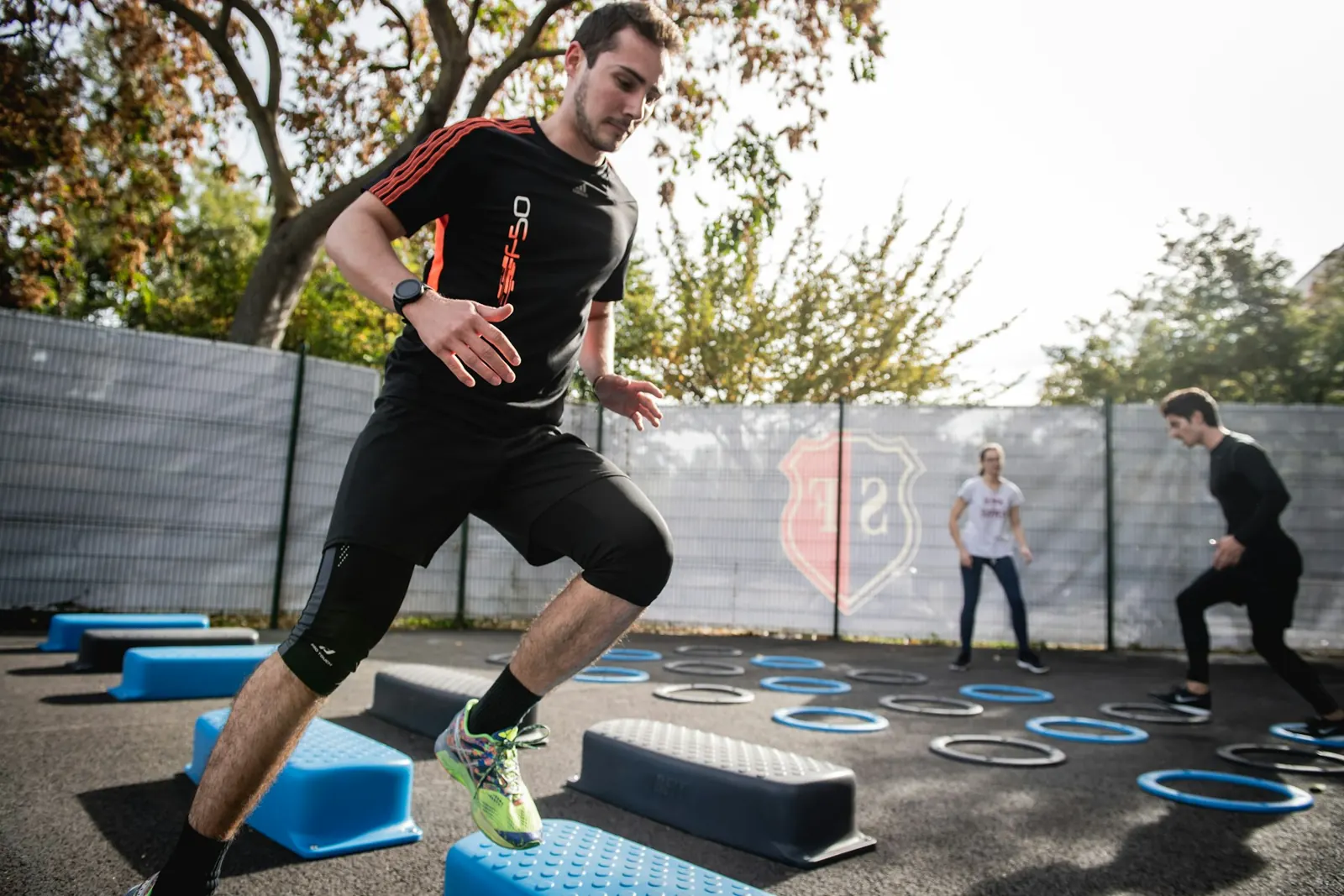
Plyometrics are jumping and bounding exercises: pogo hops, skipping, box jumps, bounding. They train your legs to absorb and return force quickly, which is exactly what running asks of them.
Several of the studies in the Blagrove review combined heavy lifting with plyometrics and found good results for running economy. Plyometrics are also demanding on tendons, so add them carefully:
- Start after 4 to 6 weeks of regular strength training.
- Begin with low-intensity drills like skipping, pogo hops and low box jumps.
- Keep the total low: 40 to 80 foot contacts a session is plenty at first.
- Do them fresh, at the start of a strength session, not when you're tired.
- Skip them if you have an active tendon or bone injury.
How to fit strength training around running
The most common worry is that lifting will leave legs too tired to run well. With some planning, it won't.
Put hard days together
Many coaches pair strength sessions with hard running days. For example: intervals in the morning, strength in the evening. That keeps your easy days genuinely easy and gives you full recovery days between hard ones. If you can only train once a day, lifting after an easy run works too.
Leave a gap when possible
If you run and lift on the same day, try to leave at least six hours between them, and do the session that matters more first. Research on "concurrent training" suggests interference is smaller when sessions are separated.
Avoid heavy lifting right before key runs
Heavy leg work the day before a long run or important interval session can leave you flat. Give yourself at least 48 hours between a heavy leg session and your most important run of the week.
Sample weekly structures
| Day | 4 runs a week | 5 to 6 runs a week |
|---|---|---|
| Mon | Rest or strength A | Easy run |
| Tue | Intervals | Intervals + strength A (evening) |
| Wed | Easy run | Easy run |
| Thu | Strength B | Tempo run |
| Fri | Easy run | Easy run + strength B |
| Sat | Rest | Rest or short easy run |
| Sun | Long run | Long run |
If most of your running is easy, as our Zone 2 training guide recommends, you'll have plenty of energy left for two short strength sessions.
A 12-week strength plan for runners
This plan assumes access to a gym or a set of adjustable dumbbells. Two sessions a week, 30 to 45 minutes each. Warm up first with 5 minutes of easy cardio and a few bodyweight squats, lunges and leg swings.
Weeks 1 to 4: learn the movements
| Session A | Sets × reps | Session B | Sets × reps |
|---|---|---|---|
| Goblet squat | 3 × 10 | Dumbbell Romanian deadlift | 3 × 10 |
| Step-up | 2 × 8 each leg | Split squat | 2 × 8 each leg |
| Calf raise (straight knee) | 3 × 15 | Calf raise (bent knee) | 3 × 15 |
| Glute bridge | 3 × 12 | Side plank | 3 × 30 sec each side |
| Front plank | 3 × 30 sec | Farmer's carry | 3 × 30 m |
Weeks 5 to 8: build strength
| Session A | Sets × reps | Session B | Sets × reps |
|---|---|---|---|
| Pogo hops | 3 × 15 | Skipping for height | 3 × 20 m |
| Back squat or heavy goblet squat | 4 × 6 | Romanian deadlift (barbell or heavy dumbbells) | 4 × 6 |
| Rear-foot-elevated split squat | 3 × 6 each leg | Step-up with dumbbells | 3 × 6 each leg |
| Single-leg calf raise, weighted | 3 × 10 each | Bent-knee calf raise, weighted | 3 × 12 |
| Hip thrust | 3 × 8 | Pallof press | 3 × 10 each side |
Weeks 9 to 12: get stronger and springier
| Session A | Sets × reps | Session B | Sets × reps |
|---|---|---|---|
| Box jumps | 4 × 4 | Bounding | 4 × 20 m |
| Back squat | 4 × 4 | Trap-bar or conventional deadlift | 4 × 4 |
| Rear-foot-elevated split squat | 3 × 5 each leg | Single-leg RDL | 3 × 6 each leg |
| Single-leg calf raise, heavy | 4 × 8 each | Bent-knee calf raise, heavy | 4 × 10 |
| Hip thrust | 3 × 6 | Weighted carry | 3 × 40 m |
Add a little weight each week when you complete all your reps with good form. Take an easier week (about half the sets) every fourth week, ideally lined up with an easier running week.

Strength training through the race season
You don't need to stop lifting when races come round. You need to lift less.
- Base phase: two full sessions a week. This is when to build strength.
- Race-specific phase: drop to one or two shorter sessions. Keep the weights heavy but cut the number of sets.
- Taper: one short, light session in the final 7 to 10 days before a key race, then nothing heavy in the last 4 to 5 days.
- After the race: a week or two of easy movement, then build back up.
Strength fades slowly. One heavy session a week is usually enough to hold onto most of what you've built for a couple of months.
Common mistakes
- Lifting too light. If you could do 20 reps but stop at 12, it isn't building much strength. Make sets challenging.
- Too much volume too soon. Huge sessions in the first week cause days of soreness that ruin your running. Start with two or three sets and build.
- Skipping calves. They're the most important muscle group for most runners and the most neglected.
- Doing it only when injured. Strength work prevents more injuries than it cures. Keep it going when you feel good.
- Chasing soreness. Feeling wrecked isn't the goal. Progressive, consistent loading is.
- Ignoring food. Strength gains need enough protein and total energy. Our fuelling guide covers what to eat around sessions.
Strength training for older runners
From middle age, muscle mass and bone density decline year by year unless you do something about it. Strength training is one of the few things that reliably slows that down. The World Health Organization's 2020 guidelines recommend muscle-strengthening activities on two or more days a week for all adults, and specifically highlight balance and strength work for older adults to reduce falls.
For older runners, the same plan works. The main differences are a longer learning phase, more attention to recovery between hard sessions, and patience with progression. If you have a heart condition, high blood pressure or joint problems, get the all-clear from your doctor first.
Getting started this week
- Pick two days that fit around your hardest runs.
- Do Session A and Session B from the first block, using weights that feel moderate.
- Write down what you lifted so you can add a little next week.
- Expect some mild soreness in the first two weeks. It fades quickly once your body adapts.
- Give it 12 weeks before judging the results.
It won't feel like running, and that's fine. Twenty minutes in the gym twice a week is some of the most useful training a runner can do.
Frequently asked questions
Will lifting weights make me bulky or slow?
No. Building lots of muscle takes years of high-volume lifting and a calorie surplus. Two short, heavy sessions a week alongside running mostly makes you stronger without adding much size.
Should I lift before or after running?
If both are on the same day, run first when running is the priority. Try to leave several hours between them, or lift on the same day as your hard run so easy days stay easy.
Can I strength train with bodyweight only?
Bodyweight work is a good start, especially for beginners. Most runners outgrow it within a few months, because bodyweight squats and lunges stop being heavy enough to build strength.
How long until I notice a difference?
Many runners feel steadier and stronger within four weeks. Measurable changes in running economy usually show up after 6 to 12 weeks of consistent lifting.
Should I keep lifting during race season?
Yes, at a lower dose. One or two short sessions a week keeps the strength you built. Drop heavy lifting in the final week before a key race.
I'm over 40. Is heavy lifting safe?
For most healthy adults, yes, with good technique and gradual progression. Strength training becomes more valuable with age because muscle and bone mass decline. Check with your doctor if you have a heart condition or other health concerns.
Sources and further reading
- Lauersen JB, et al. The effectiveness of exercise interventions to prevent sports injuries: a systematic review and meta-analysis of randomised controlled trials. British Journal of Sports Medicine, 2014;48(11):871-7. DOI PubMed
- Blagrove RC, et al. Effects of Strength Training on the Physiological Determinants of Middle- and Long-Distance Running Performance: A Systematic Review. Sports Medicine, 2018;48(5):1117-1149. DOI PubMed
- Balsalobre-Fernández C, et al. Effects of Strength Training on Running Economy in Highly Trained Runners: A Systematic Review With Meta-Analysis of Controlled Trials. Journal of Strength and Conditioning Research, 2016;30(8):2361-8. DOI PubMed
- Støren O, et al. Maximal strength training improves running economy in distance runners. Medicine and Science in Sports and Exercise, 2008;40(6):1087-92. DOI PubMed
- Beattie K, et al. The Effect of Strength Training on Performance Indicators in Distance Runners. Journal of Strength and Conditioning Research, 2017;31(1):9-23. DOI PubMed
- Bull FC, et al. World Health Organization 2020 guidelines on physical activity and sedentary behaviour. British Journal of Sports Medicine, 2020;54(24):1451-1462. DOI PubMed
This guide is general education, not a diagnosis or treatment plan. If you have pain that is severe, getting worse or not improving after two to three weeks, see a doctor or physiotherapist. Read our full medical disclaimer.
Photography: Unsplash contributors. Published 14 October 2026, last reviewed 14 October 2026.